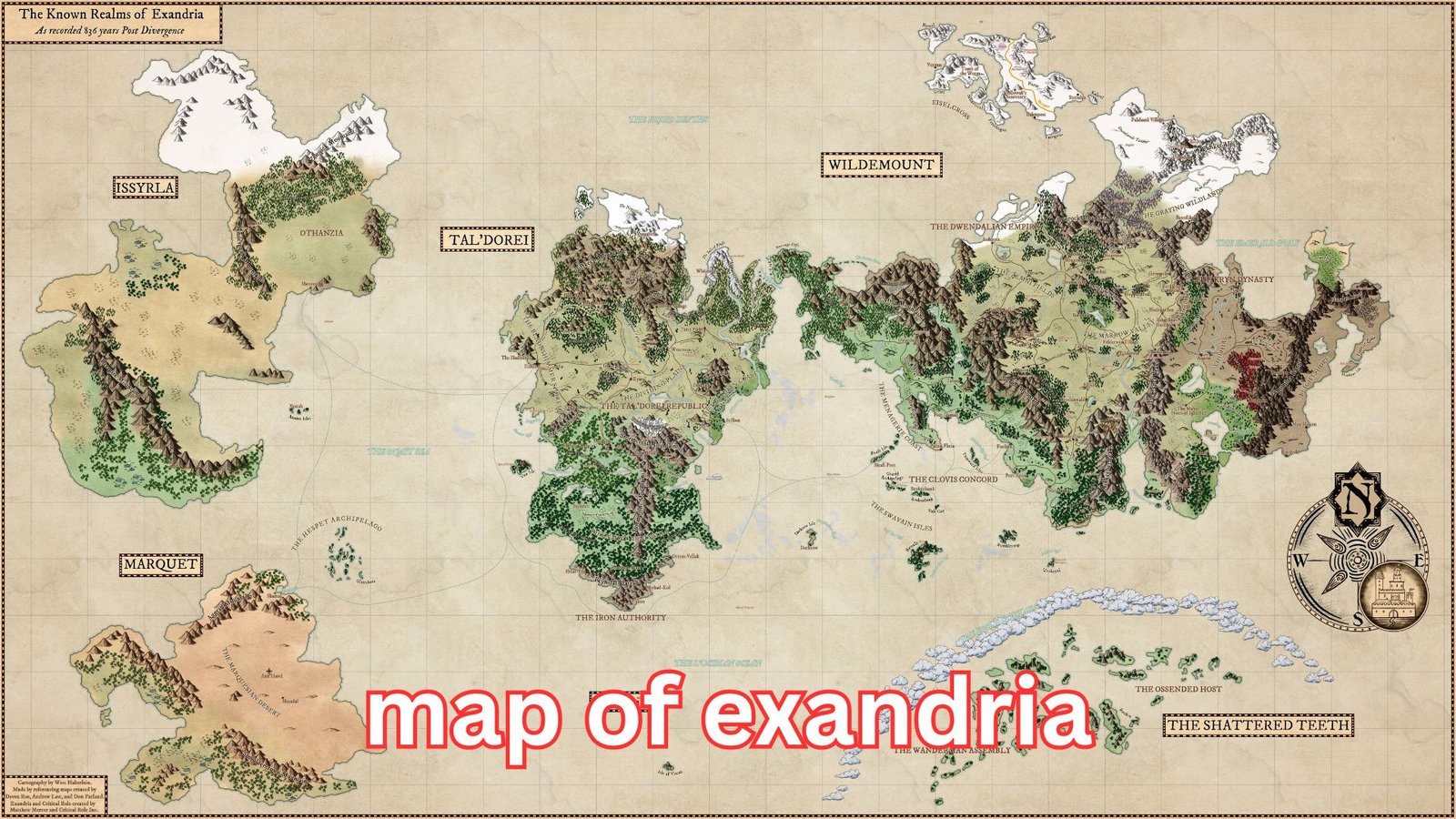
The map of Exandria is more than a simple fantasy illustration; it is the visual heartbeat of one of the most beloved tabletop universes ever created. For fans of high-fantasy storytelling, immersive role-playing, and rich worldbuilding, this detailed cartographic masterpiece offers a gateway into continents shaped by ancient gods, shattered empires, and legendary heroes. Whether you discovered the setting through livestreamed campaigns or deep lore explorations, understanding the geography behind the adventures unlocks an entirely new layer of appreciation.
The Origins of Exandria and Its Expansive Worldbuilding
Exandria is the primary setting of the acclaimed web series Critical Role, created and led by Matthew Mercer. What began as a home tabletop campaign evolved into a globally recognized storytelling phenomenon. As the narrative grew, so did the need for a comprehensive world map that could ground epic adventures in tangible space.
Fantasy maps have always played a crucial role in immersive storytelling. From ancient myth-inspired landscapes to modern high-fantasy worlds, geography shapes politics, culture, and conflict. In Exandria, coastlines define trade routes, mountain ranges guard hidden cities, and mysterious seas conceal powerful relics. The world’s layout is not decorative; it is foundational.
The cartography of this realm reflects years of creative refinement. Continents were introduced campaign by campaign, each revealing new civilizations, histories, and magical anomalies. Over time, the world became interconnected in ways that reward close study.
Understanding the Map of Exandria
The map of Exandria showcases multiple continents, sprawling oceans, and diverse biomes that host the setting’s adventures. Rather than focusing on a single kingdom, the design presents a living, breathing world system. Major landmasses include Tal’Dorei, Wildemount, Marquet, and Issylra, each carrying distinct cultural identities.
Tal’Dorei serves as the backdrop for early heroic exploits, featuring coastal cities, ancient ruins, and political alliances forged in battle. Wildemount expands the world eastward with warring empires, icy tundras, and morally complex storylines. Marquet introduces desert kingdoms and vibrant trade hubs, while Issylra carries spiritual and historical significance tied to ancient divine conflicts.
Oceans and seas are equally important. The Lucidian Ocean separates continents and enables naval trade, piracy, and exploration. Island chains scattered across the waters provide narrative flexibility for side quests and hidden dangers.
By studying this world map, fans can trace character journeys, visualize campaign arcs, and better understand how geography shapes narrative tension.
Continental Diversity and Cultural Depth
Each continent within Exandria reflects intentional design choices that influence storytelling. Tal’Dorei embodies classic high-fantasy elements with noble cities and arcane institutions. Wildemount introduces political nuance through rival nations and ideological conflict. Marquet blends desert landscapes with cosmopolitan culture, expanding the aesthetic beyond traditional medieval Europe-inspired settings.
The diversity across these regions is not merely environmental. Languages, belief systems, architecture, and social structures differ dramatically from one territory to another. This variety adds realism and depth, making the fantasy realm feel historically layered rather than artificially assembled.
Geographical barriers play a major role in shaping these distinctions. Mountain ranges isolate civilizations, dense forests conceal druidic communities, and frozen wastelands discourage expansion. Natural obstacles create believable boundaries that influence trade, warfare, and diplomacy.

The Role of Cartography in Storytelling
Fantasy cartography serves both functional and emotional purposes. On a practical level, it helps players and viewers track travel distances, military movements, and political borders. On a deeper level, it creates anticipation. Seeing an unexplored region on parchment sparks curiosity long before characters ever set foot there.
In long-form narrative campaigns, geography adds stakes. A perilous journey across a desert feels more intense when viewers can visualize the distance involved. Naval voyages gain weight when storms threaten ships in vast open waters. The physical world reinforces narrative tension.
The map of Exandria also enhances continuity. As campaigns progress and timelines shift, returning to familiar cities offers a sense of history. Landmarks become nostalgic touchstones for longtime followers.
Artistic Design and Visual Appeal
Beyond its narrative function, the visual design of Exandria’s world map contributes significantly to its popularity. Detailed coastlines, stylized mountain icons, and carefully inked typography give it the appearance of a classic fantasy atlas. The artistry evokes traditional parchment maps while maintaining modern clarity.
Color palettes often vary between official releases, highlighting climate differences. Warmer tones emphasize desert regions, cooler hues define arctic territories, and lush greens dominate temperate forests. These visual cues immediately communicate environmental identity.
The balance between decorative detail and readability is particularly impressive. Major cities stand out without overwhelming the terrain, while natural landmarks remain distinguishable even at reduced scale. This makes the map suitable for both storytelling and display purposes.
Canon Expansions and Published Materials
As the world gained popularity, official guidebooks expanded on its geography and lore. Publications connected to Critical Role offer detailed regional breakdowns, city descriptions, and historical timelines that align with the world’s visual layout.
Campaign sourcebooks deepen understanding by explaining borders, trade routes, and ancient ruins not fully explored onscreen. These expansions allow tabletop players to run their own adventures within the same global framework.
The animated adaptation, The Legend of Vox Machina, further popularized Tal’Dorei’s geography by visually rendering locations once only described verbally. Seeing cities and landscapes animated brought renewed interest in studying the broader continental arrangement.
Symbolism and Mythic Geography
Exandria’s geography reflects its mythic past. The Calamity, a catastrophic divine conflict in ancient history, reshaped the world’s terrain. Scars from this era remain visible in desolate regions and corrupted lands.
Sacred mountains mark sites of divine intervention, while shattered wastelands hint at forgotten wars. Oceans once calm were altered by arcane cataclysms. These environmental remnants reinforce the theme that history leaves permanent marks on the physical world.
By connecting myth to landscape, the setting achieves narrative cohesion. Events are not abstract lore entries; they are etched into cliffs, deserts, and coastlines.

Fan Engagement and Community Creativity
The popularity of Exandria’s geography extends beyond official publications. Fans create custom versions of the world map, annotate campaign routes, and design speculative expansions. This collaborative creativity strengthens community engagement.
Cosplayers, artists, and dungeon masters use the world layout as inspiration for original content. Some reinterpret city designs, while others imagine unexplored islands beyond charted waters. The map acts as both canonical reference and creative springboard.
Because the world feels expansive rather than closed, audiences can insert their own stories without contradicting established lore. That openness contributes to its longevity.
Why the Map Continues to Captivate
The enduring fascination with Exandria’s geography lies in its layered design. It balances clarity with mystery. Major continents are defined, yet distant territories remain unexplored. Political boundaries are established, yet cultural evolution continues.
The map of Exandria provides structure without limiting imagination. It invites exploration while honoring established canon. For storytellers, it offers a ready-made foundation. For viewers, it enhances immersion.
Fantasy settings often succeed or fail based on how convincingly their worlds feel inhabited. In this case, cities are not random markers; they have economies, leadership, and historical context. Forests are not empty backdrops; they hide druidic enclaves or ancient ruins. Deserts are not generic expanses; they carry trade networks and cultural traditions.
Geography becomes character.
The Lasting Impact on Modern Fantasy
In the broader landscape of contemporary fantasy media, Exandria stands as proof that collaborative storytelling can rival traditional novels in depth and cohesion. Its cartography demonstrates how visual worldbuilding strengthens narrative longevity.
The influence of this setting can be seen in the rise of streamed tabletop campaigns and expanded multimedia adaptations. Viewers increasingly value cohesive world design that supports character-driven plots. A carefully constructed global layout elevates the experience beyond episodic adventure.
As the franchise continues to grow, new regions may be revealed, and existing territories may evolve. Yet the foundational layout remains a testament to deliberate creative planning.
Conclusion
The map of Exandria is far more than decorative fantasy art. It is a storytelling engine, a historical archive, and a creative invitation. By weaving geography, myth, politics, and artistry into a unified design, the world achieves remarkable depth and coherence.
For longtime fans and newcomers alike, studying this epic realm enhances every campaign episode, guidebook page, and animated adaptation. The continents feel lived-in, the oceans feel vast, and the history feels tangible. In the realm of modern fantasy worldbuilding, few settings demonstrate the power of cartography as effectively as Exandria.
Also Read: Bad Idea Nashville: The Shocking Truth Behind the City’s Bold Reputation